
Wood Pellets for Heating: Hardwood Types, Quality and Ash
The hardwood label alone doesn’t tell you whether a fuel will suit your heating system. When choosing wood pellets, compare the wood type with the product’s stated quality standard and the amount of ash it leaves behind. These details offer a clearer basis for comparing wood pellets than hardwood content alone.
Hardwood may seem like the obvious choice, but wood species is only one factor in pellet performance. Product quality and ash residue also affect what you buy and how often you clean your appliance.
This guide covers common hardwood feedstocks, what quality standards can tell you, and how ash residue fits into your decision. Use it to compare wood pellets for heating and identify details that matter for your equipment and fuel handling.
Key Takeaways
- Compare hardwood types by more than their name; the feedstock alone doesn’t determine how a pellet performs.
- Use quality standards to assess key fuel characteristics and make product comparisons more consistently.
- Consider ash residue when weighing cleaning needs and fuel suitability for your heating equipment.
- Understand how the hopper and auger feed fuel to the burn pot to see what matters in stove and boiler operation.
Hardwood pellet varieties and wood types
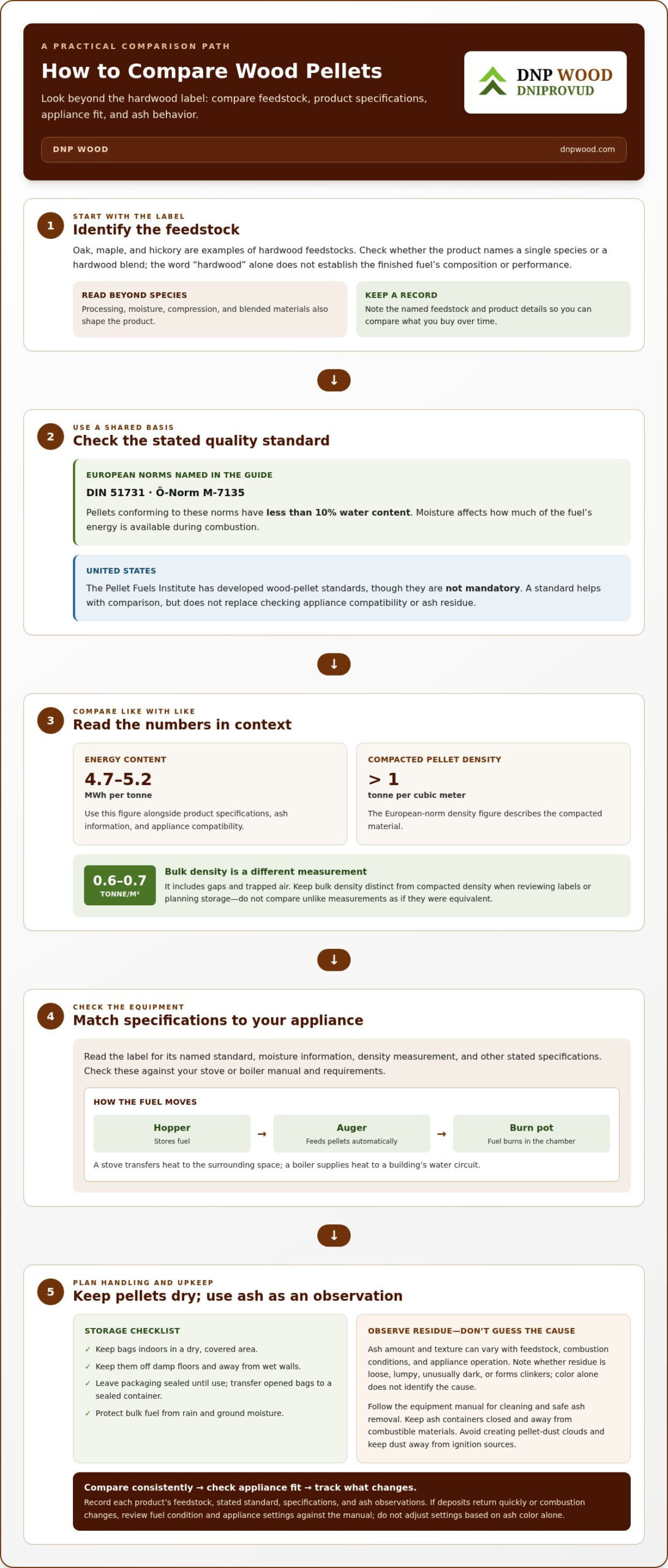
Oak, maple, and hickory are examples of hardwood feedstocks. Their names describe the wood, not every feature of the finished fuel. Processing, moisture, compression, and blended materials also shape the product. Treat species as one point of comparison. When comparing wood pellets, read the full product description and distinguish a single-species claim from a hardwood blend.
A label may name one species, such as oak, or describe a mix. That distinction can help you track what you buy over time. Compare the listed feedstock and quality information with your appliance requirements. Don’t assume that two products labelled “hardwood” have the same composition or will perform identically in your system.
Wood pellets contain approximately 4.7 - 5.2 MWh per tonne. Use that energy-content figure alongside product specifications, ash information, and appliance compatibility. The species label alone doesn’t establish performance. Keep a simple comparison record with the named feedstock, stated standard, and product details for each option.
Comparing heating costs for firewood, propane, and natural gas depends on delivered fuel cost, energy content, and appliance efficiency. Compare the useful heat each system provides; fuel price alone does not determine the overall cost.
For residential heating in the United States, permit requirements and available tax credits depend on location, equipment, and installation. Before deciding on a project, identify the relevant state and local rules and check the current criteria for any credit. Hardwood type alone does not determine eligibility.
To protect pellets from moisture, store bags indoors in a dry, covered area. Keep them off damp floors and away from wet walls. Leave packaging sealed until use, and transfer opened bags to a sealed container. For bulk storage, use an enclosure that blocks rain and ground moisture. Inspect the bags and storage area before filling the hopper.
Wood pellet quality standards
A quality standard gives buyers a shared basis for comparing fuel. Commonly used European norms include DIN 51731 and Ö-Norm M-7135. Wood pellets conforming to these norms have less than 10% water content. Moisture affects how much of the fuel’s energy is available during combustion. Use the named standard as a starting point, then compare the product’s stated specifications with your appliance requirements.
Density needs careful interpretation. Under these European norms, pellet density is higher than 1 ton per cubic meter. That measurement describes the compacted material, not the volume occupied by a loose load. Bulk density, which includes gaps and trapped air, is about 0.6-0.7 ton per cubic meter. Keep these figures distinct when planning storage or reviewing product data.
In the United States, the Pellet Fuels Institute has developed standards for wood pellets, though they are not mandatory. A standard can still help you compare products. Read the label for the named standard and specifications, then check them against your stove or boiler manual. A standard does not replace checking appliance compatibility or considering ash residue.
Use the same process for each product. Record its standard, moisture information, density measurement, and any other stated specifications. Make sure each figure refers to the same measurement before comparing options. For example, don’t compare compacted density on one label with bulk density on another. This prevents unlike measurements from being treated as equivalent and keeps purchasing decisions grounded in clear product data.
Product information should also fit your storage and handling plan. Consider how the fuel will be kept dry and moved into the appliance. These practical details complement the label, but they don’t replace its specifications. For supply information, review wood fuel supply details alongside your heating system’s requirements.
Pellet ash residue
Ash is the solid material left after fuel burns. Its amount and texture can vary with feedstock, combustion conditions, and appliance operation. Pale, fine residue and darker clinkers are different observations, but neither reveals the cause on its own. Note what you see after each cleaning. Changes over time can help you spot a fuel or operating change worth investigating.
Follow your stove or boiler manual for ash removal and cleaning. Wait until the appliance reaches the condition specified by its manufacturer before removing residue. Use the designated ash pan or compartment, and avoid scattering ash indoors. Fine particles can become airborne during handling. Keep the collection container closed and away from combustible materials until disposal.
Health and environmental risks extend beyond the ash pan. Burning produces ash residue, while combustion emissions are separate and cannot be judged by ash volume alone. Fine dust released when handling pellets can create a serious dust-explosion hazard. Avoid creating dust clouds when transferring fuel, and keep dust away from ignition sources. Follow local waste guidance for ash disposal; don’t assume residue is suitable for gardens or drains.
Follow a simple inspection routine. Once the appliance is cool and ready for service, inspect the burn pot, ash pan, and surrounding area. Note whether residue is loose, lumpy, or unusually dark. Remove buildup as directed by the equipment instructions, then check that airflow openings are clear. If deposits return quickly or combustion changes, review the fuel condition and appliance settings against the manual. Don’t adjust settings based on ash colour alone. Regular cleaning keeps residue visible and makes changes easier to track. Follow the equipment maker’s instructions for cleaning frequency and safe ash handling.
How do wood pellet stoves and boilers work?
A pellet appliance stores fuel in a hopper and moves it towards the combustion chamber as needed. In a pellet stove, a mechanical auger automatically feeds pellets from the hopper into a burn pot, where the fuel burns. This automatic feed distinguishes pellet appliances from systems that require logs to be added by hand.
During operation, combustion produces heat that the appliance transfers to a room or water circuit. A stove heats the surrounding space, while a boiler supplies heat to a building’s distribution system. The exact arrangement depends on the equipment. In both cases, the hopper, auger, burn area, and heat-transfer components work together to turn stored fuel into useful heat.
Controls coordinate fuel feed and combustion. The appliance’s operating settings regulate how fuel reaches the burn pot. Depending on the system design, a room thermostat or boiler control can signal a demand for heat. Follow the manufacturer’s instructions for startup, settings, cleaning, and shutdown. Controls and maintenance steps vary by model.
Fuel selection is part of reliable operation. Check the manual for the fuel type and specifications your appliance accepts. Pellet size, condition, and storage can affect how consistently fuel moves through the hopper and auger. Keep the feed path clear and use dry fuel. If material bridges or blocks the feed mechanism, don’t force it into the hopper. Resolve the cause before restarting the system.
Routine care supports steady combustion. Inspect the burn pot and ash area as directed by the manufacturer. Remove residue and clear openings according to the manual. If the unit stops feeding, check for an empty hopper or visible blockage before changing settings. Don’t bypass safety features or dismantle equipment beyond the user-maintenance steps described in the instructions.
For fuel planning, compare appliance requirements with available pellet fuel options before arranging a supply.
Austria had fully automatic wood-pellet boilers with a comfort level similar to oil and gas boilers by 1997. This offers a historical point of comparison for understanding how automation can make pellet heating resemble familiar boiler operation, while the particular functions and user experience still depend on the appliance and its controls.
DNP Wood: Sunflower Husk Pellet
DNP Wood offers Sunflower Husk Pellet alongside its Wood Pellet product. If you’re comparing pellet feedstocks, these options provide a basis for discussing product type and intended use. Check your appliance’s requirements before choosing fuel, since pellet products are not automatically interchangeable. DNP Wood also offers Alfalfa Hay Pellets, a separate product category for buyers considering pellet materials beyond wood.
Let your equipment’s specifications guide your next step. Compare product information with those requirements, including any stated fuel type and quality criteria. This keeps your choice grounded in appliance compatibility rather than the pellet’s name alone.
Contact DNP Wood to discuss its pellet products and your purchasing needs.
Build a Clear Buying Plan
Before your next order, turn your comparison into a purchasing record. Note your appliance model, the fuel type its manual accepts, and the product information relevant to your operation. Keep the same criteria for future purchases. This makes changes in fuel or equipment easier to assess over time.
A practical record can include the product name, stated standard or specifications, storage arrangements, and cleaning observations. Use the appliance maker’s instructions to check compatibility. Tie each selection to your equipment and operating needs rather than relying on a hardwood label alone.
DNP Wood offers Sunflower Husk Pellet, Wood Pellet, and Alfalfa Hay Pellets. Use your purchasing criteria to identify which product category fits your requirements. For the next step, send DNP Wood a wood pellet inquiry. A clear buying plan helps keep the decision focused.
Frequently Asked Questions
What are wood pellets and how are they made?
Wood pellets are compact fuel pieces made from processed wood material. Producers typically prepare the feedstock, press it through a die, then cool and package the formed pellets. The material may come from sawdust or other wood-processing residues. For buyers, the key point is that the feedstock and production process influence the finished product, so compare the product label with your appliance requirements.
What are wood pellets commonly used for in the United States?
In the United States, households commonly burn wood pellets in pellet stoves and boilers for space or water heating. The appliance’s hopper stores the fuel, and its feed mechanism delivers it to the burn area. Some large facilities also use wood pellets to generate heat or electricity. For home use, check the equipment manual first, since fuel requirements differ between appliances.
What wood pellet grades and certifications should buyers look for?
U.S. buyers can look for products aligned with Pellet Fuels Institute standards; those standards are voluntary, not mandatory. Check the label for the named standard and compare its specifications with your appliance manual. DIN 51731 and Ö-Norm M-7135 are commonly used European norms, not U.S. grades. A certification or standard name helps organize comparisons, but it doesn’t replace checking appliance compatibility.
Posted in Uncategorized Tagged ash residue, hardwood pellets, pellet boilers, pellet quality, pellet stoves, wood heating, wood pellets Add new comment