
Sunflower Husk Pellets: Uses, Specifications, Cost and Durability
Sunflower husk pellets are made by compressing the shells left after sunflower seeds are processed. These cylindrical biomass fuel pellets can be used for industrial heating and power generation. Their practical value depends on more than the feedstock: buyers also assess fuel properties, handling requirements, and compatibility with existing equipment. Evaluate sunflower husk pellets against the specific job they are expected to do.
For procurement teams, one specification cannot answer every question. Sunflower husk pellets can vary between batches, so assess how they will be stored, moved, and used. This guide covers their production and applications, along with dimensions, moisture, durability, cost factors, and environmental claims. Use it to compare the fuel with operational needs and identify which details matter most before purchasing.
Key Takeaways
- Assess fuel use by comparing heat output and ash characteristics with the requirements of the heating or power system.
- Use pellet dimensions and moisture as practical indicators for storage, feeding and handling.
- Understand how seed dehulling creates the feedstock, and consider processing and transport when evaluating environmental claims.
- Judge durability alongside moisture and handling conditions; evaluate cost in the context of pellet format and use.
Industrial heating and power plant uses
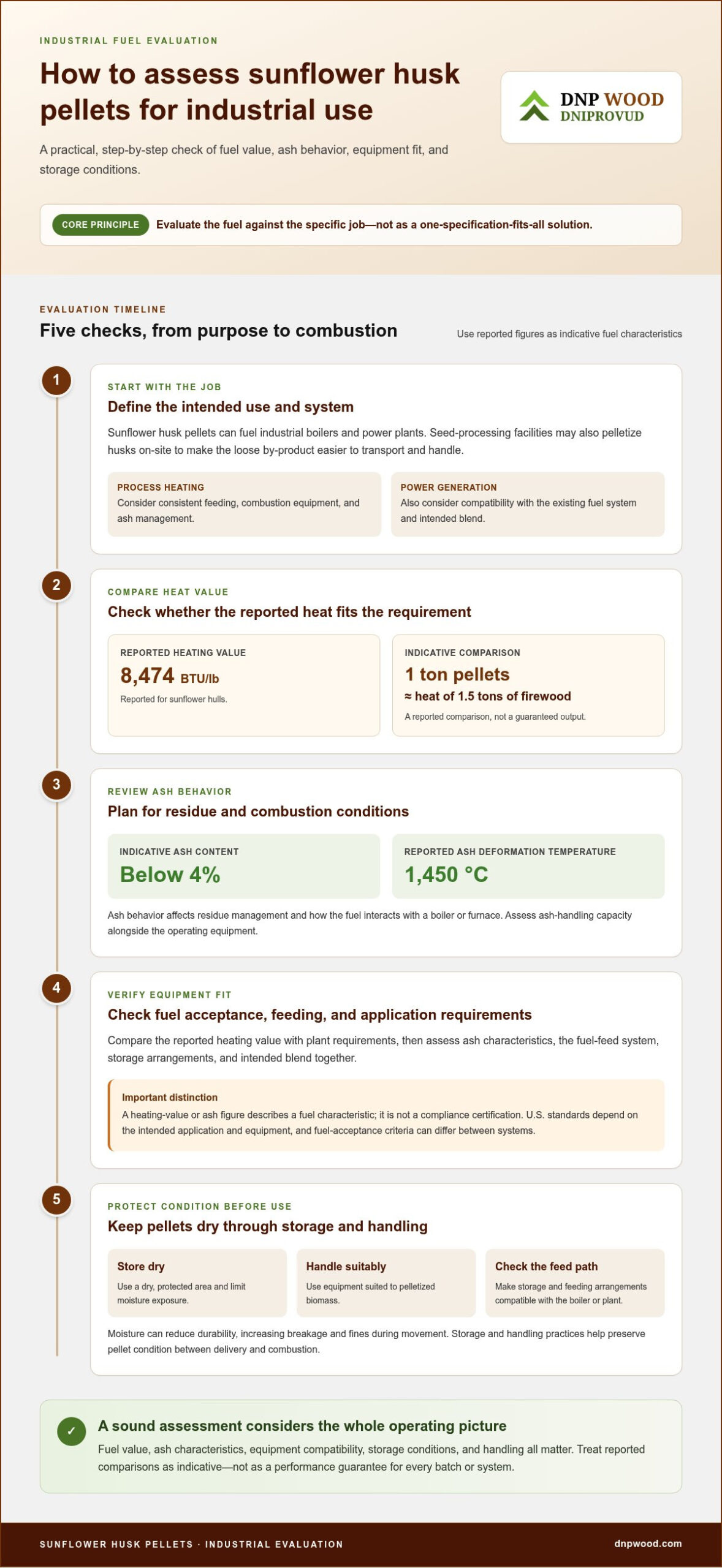
Industrial boilers and power plants can use sunflower husk pellets as solid biomass fuel. Seed-processing facilities can also pelletize husks on-site, making the loose by-product easier to transport and handle. For heating, assess whether fuel characteristics suit the combustion equipment. The reported heating value of sunflower hulls is 8474 BTU/lb. One reported comparison says one ton of pellets produces as much heat as 1.5 tons of firewood. Treat these as indicative comparisons, not guaranteed output for every batch or system.
Combustion performance involves more than heat value. Indicative ash content is below 4%, and the reported ash deformation temperature is 1450 °C. Ash behavior affects residue management and how fuel interacts with a boiler or furnace. A power plant assessing sunflower husk pellets should consider its operating equipment, fuel-feed system, ash-handling capacity, and intended blend. Industrial heating operations need the same practical assessment for their process equipment.
U.S. standards depend on the intended application and equipment. A heating-value or ash figure describes a fuel characteristic, not a compliance certification. A power plant’s fuel-acceptance criteria may differ from the requirements for a particular heating appliance. The values listed help characterize sunflower husk pellets, but do not establish compliance for every U.S. use or installation.
For storage and handling, keep pellets dry and limit their exposure to moisture. Moisture can reduce durability, increasing breakage and fines during movement. Store the fuel in a dry, protected area and use equipment suited to handling pelletized biomass. Ensure storage and feeding arrangements are compatible with the boiler or plant system. These practices help preserve pellet condition between delivery and combustion.
Assess the fuel against the job. A process-heat facility may prioritize consistent feeding and ash management, while a power plant may also consider compatibility with its existing fuel system. Compare the reported heating value with plant requirements, then assess ash characteristics and storage conditions together. This provides a practical basis for evaluating sunflower husk pellets without treating one specification as a complete performance guarantee.
Pellet dimensions and moisture
Sunflower husk pellets can vary in size, moisture, and bulk density between batches. These properties affect storage volume, movement through feeding equipment, and the amount of fuel held in a given space.
Pellet Dimensions and Density
Pellet dimensions describe each cylinder’s diameter and length; density indicates how much pellet mass occupies a volume. Reported diameters range from 4-10 mm, with average lengths of 10-30 mm and some pellets reaching 50 mm. This variation matters when matching fuel to storage, conveyors and feed systems. A consistent size profile helps equipment handle fuel predictably, while short or broken pieces can behave differently during transfer.
Bulk density figures also vary: one reported indicative value is 550 kg/m³, while another gives 250 kg/m³ for pellets and 70-100 kg/m³ for loose hulls. These figures describe different reported measurements, so assess density alongside the measurement method and batch details. Higher bulk density generally means more fuel occupies less storage volume, but dimensions and handling conditions also influence how efficiently a system can store and move the material.
Moisture Characteristics
Moisture content is the proportion of water held in the pellets, and reported figures vary by production and handling stage. Common production moisture is approximately 8-10%, with other reported figures ranging from 6-9% and below 10%. This variation affects comparisons between batches, so treat moisture as a key specification alongside density and dimensions.
Moisture changes can affect storage and handling. Newly produced pellets are reported at about 60-80 degrees Celsius and around 15% moisture before cooling; cooling to about 3-4% is described as aiding storage. These are process-stage figures, not a single universal delivery specification. Origin, composition, processing and storage all contribute to batch differences. For buyers comparing lots, review moisture on the same basis and consider whether storage conditions could change it after delivery.
For a practical comparison of fuel formats, explore biomass pellet options alongside the dimensions and moisture relevant to your equipment.
Sunflower husks as a by-product of seed dehulling
Sunflower husks are the outer shells separated during seed processing for oil extraction or bakery use. To make pellets, prepared husks are compressed through die holes under high pressure, turning loose residue into a transportable solid fuel.
Sunflower Husks as Biofuel Feedstock
Dehulling creates a usable biomass feedstock alongside kernels destined for food or oil production. Processing 100 kg of sunflower seeds containing 25% hulls yields 16.5 kg of hulls. After well-managed dehulling, hulls make up 18-22% of the remaining kernels. These figures describe different processing points, so they should not be treated as interchangeable yield estimates.
Oil and seed producers have long pelletized husks on-site to simplify logistics and transport. This turns a light, loose by-product into compact fuel units that are easier to move in bulk. For buyers, feedstock origin and processing matter because they shape the material entering the pellet line and can contribute to batch variation.
Husk Fuel Properties
Fuel properties describe the energy content and combustion-related characteristics of the husks or their pellets. Reported values include a net calorific value of 16-17 Gj/MT and a calorific value of 4.3-4.5 kW/kg. The heat of combustion is reported as at least 16 MJ/kg. These measures use different units and should be compared on their stated basis.
A reported ash content for sunflower hulls is 2.86%, while sulfur content is 0.14%. Ash and sulfur figures help characterize fuel, but do not alone establish performance in a specific furnace. Compare them with heat value and the equipment’s fuel and residue handling needs. Pelletizing makes the material more practical to transport, while its feedstock remains an agricultural processing by-product.
Pellet durability, cost, and environmental claims
Durability affects handling losses, while cost comparisons depend on the delivered fuel and its usable heat. Environmental claims should also account for processing and transport.
Durability and Cost
Pellet durability describes how well pellets resist breaking during storage and handling. The reported durability index is 18, a figure useful only alongside its test method and comparable batch data. Moisture can weaken pellets, increasing breakage and fines during movement. For a buyer, damaged material can complicate feeding and reduce the usable share of a delivered load.
Compare purchase terms by considering delivered quantity, packaging, transport, and fuel performance together. Bulk and big-bag shipments involve different handling and storage requirements, so the lowest quoted unit price may not represent the best operating value. Compare equivalent quantities and account for the receiving system’s handling needs.
Environmental Claims and Emissions
An environmental claim should account for impacts across feedstock sourcing, pellet production, transport, and combustion. Sunflower husks are a by-product of seed processing, but that alone does not prove a fuel is carbon-neutral or has lower total emissions. Pelletizing and delivery are also part of the assessment.
Burning produces combustion emissions, but the fuel figures here do not quantify their composition or exposure-related health risks. These depend on the actual combustion process and operating conditions; a pellet specification alone cannot establish exposure at a facility.
Assess environmental statements by identifying their scope: feedstock origin, processing energy, transport distance, or emissions during use. A claim covering only the agricultural by-product leaves out later stages. For a practical comparison, weigh each stage against the fuel’s intended use and handling requirements rather than relying on a broad label.
Review DNP Wood’s sunflower husk pellet offering when comparing this fuel with your handling and storage requirements.
DNP Wood: Sunflower Husk Pellet
DNP Wood offers Sunflower Husk Pellet for buyers assessing this biomass fuel for their operations. It is a relevant option when feedstock type and pellet fuel are part of your purchasing decision. Before choosing a material, compare its dimensions, moisture, durability, and fuel properties with your storage and handling requirements.
DNP Wood also offers Wood Pellet and Alfalfa Hay Pellets, giving buyers other pellet materials to consider for their requirements. Wood Lumber is available for buyers sourcing a solid-wood product alongside biomass materials.
Use your equipment, storage arrangements, and intended application to guide your product comparison. Contact DNP Wood to discuss Sunflower Husk Pellet for your operation.
Plan Your Next Fuel Assessment
Make the next step a practical fit assessment. Define the role sunflower husk pellets would serve, then align purchasing decisions with your operation’s fuel-handling, storage, and combustion needs. This turns product information into criteria your team can use during procurement and ongoing fuel evaluation.
Keep the assessment focused on your actual use case. Clear requirements help your team compare materials consistently and identify which details matter most to operations. They also give suppliers a useful basis for discussing product fit without relying on broad environmental or performance claims.
DNP Wood supplies biomass products for buyers comparing pellet options. Contact the company to discuss a product based on your application and purchasing needs.
Contact DNP Wood to discuss pellet options and take the next step with a clear assessment plan.
Frequently Asked Questions
What are sunflower-husk fuel pellets used for?
Sunflower husk pellets are used as solid biomass fuel for industrial heating and power generation. They can also help seed processors turn loose hull residue into more manageable fuel. A facility assessing this option should consider its combustion equipment, fuel-feed setup, and ash-handling arrangements. These factors help determine whether the material suits the intended operation.
What heating value and ash content do these pellets have?
Reported heating value for sunflower hulls is 8474 BTU/lb, and indicative pellet ash content is below 4%. A separate reported hull ash figure is 2.86%. These values refer to different material descriptions, so compare specifications on the same basis. The relevant operating question is how the fuel’s heat output and residue characteristics fit the plant’s requirements.
How do they compare with wood pellets and other biomass fuels?
The feedstock is the main distinction: sunflower husk pellets use seed-processing hulls, while wood pellets use wood-based material. Neither fuel is automatically the better fit. Compare usable heat, ash, moisture, dimensions, storage needs, and equipment compatibility. For example, a facility already handling wood pellets can assess whether its existing feed system and residue management suit another biomass fuel.
What is the cost per ton in the United States?
Delivered cost depends on shipment terms, order size, packaging, and transport distance. Bulk and bagged loads also differ in unloading and storage requirements. For a useful comparison, assess the delivered quantity and identify whether packaging, transport, and unloading are included. Comparing equivalent delivery terms gives procurement teams a clearer basis than a headline price alone.
Where can U.S. buyers purchase sunflower-hull pellets?
DNP Wood offers Sunflower Husk Pellet to customers globally. Buyers can consider it for their biomass fuel requirements and discuss purchasing needs through DNP Wood’s sales channel. The company also offers Wood Pellet and Alfalfa Hay Pellets. Align your selection with the intended use and your facility’s receiving, storage, and fuel-handling arrangements.
Are sunflower-hull pellets compatible with standard pellet stoves and boilers?
Compatibility depends on the appliance’s permitted fuel type and operating requirements. Relevant factors include the feed mechanism, pellet dimensions, combustion controls, and ash-handling design. A feed path designed for a particular pellet size may not handle a different size consistently. Match fuel characteristics with the appliance documentation before use, especially when considering equipment designed for another biomass fuel.
Posted in Uncategorized Tagged biomass fuel, fuel procurement, industrial heating, pellet specifications, power generation, renewable energy, sunflower husk pellets Add new comment